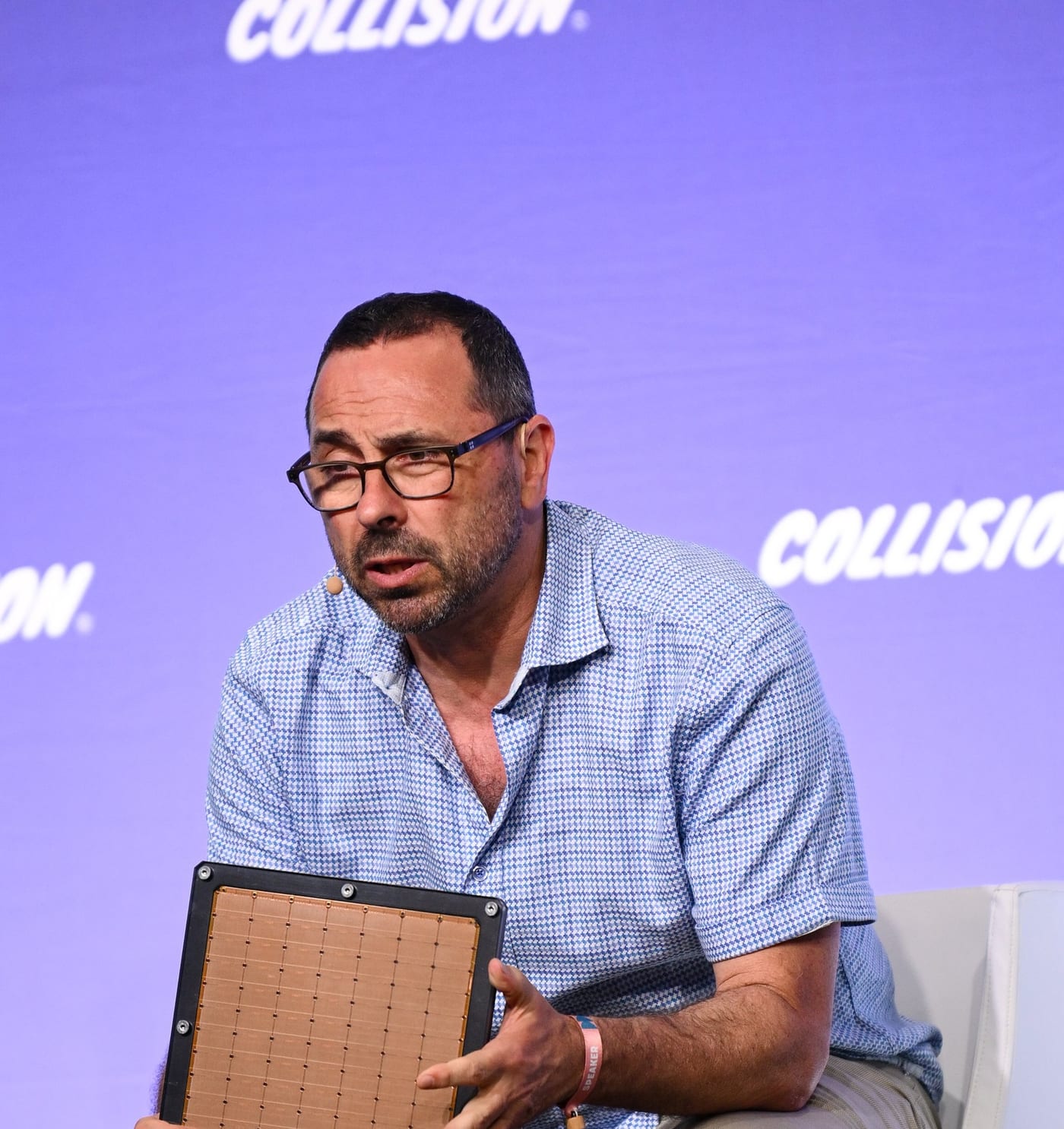
Cerebras Systems raised its full-year forecast and reported a Core profit on Thursday, then watched its shares jump on Friday, the first regular session after Jensen Huang resigned as Nvidia’s chief executive. The question hanging over the tape was whether the AI-chip trade was rotating away from Nvidia. Friday’s close did not settle it.
Cerebras stock gained more than 14% in premarket trading Friday, Reuters reported, after the company beat its own guidance and lifted its 2026 outlook. The shares closed at $108.72, up 11.22% from Thursday’s close of $97.75, according to Yahoo Finance data, still well below the $185 price of its May initial public offering.
Huang resigned as Nvidia’s president, chief executive, and a director on Thursday, effective immediately, Nvidia said in a newsroom statement. The board named chief financial officer Colette Kress as interim CEO.
Cerebras, which sells wafer-scale AI processors, reported results after the close on Thursday for the quarter ended Sept. 30.
Under generally accepted accounting principles, the company posted record revenue of $210.8 million, up 55% from a year earlier, according to the press release furnished with its 8-K filing. It recorded a GAAP net loss of $161.2 million, or 67 cents a share, wider than a year-earlier loss of $22.2 million, or 41 cents a share. Stock-based compensation of $155.1 million accounted for most of the gap between that GAAP loss and the company’s adjusted results.
Cerebras also reports Core figures, a non-GAAP measure that excludes stock-based compensation, the non-cash amortization of customer warrants, data-center pass-through revenue and costs, and certain other items. Core revenue was a record $230.9 million, up 70%, the 8-K shows, led by Core cloud and other services revenue of $144.9 million, up 272%. On that basis, the company swung to Core net income of $29.8 million from a Core net loss of $10.9 million a year earlier.
Those Core results beat the August outlook in Cerebras’s second-quarter 8-K of $214 million to $216 million in Core revenue. The company raised its full-year 2026 Core revenue outlook to $940 million to $960 million, from $880 million to $890 million, and guided to fourth-quarter Core revenue of about $310 million to $330 million. Analysts, on average, had expected full-year sales of $887.04 million, Reuters reported, citing LSEG data.
“Cerebras’ technology remains the undisputed champion of speed,” Andrew Feldman, the company’s co-founder and chief executive, said in the release. “We’re giving customers more ways to access our technology and scale with us be it through direct system sales, Cerebras Cloud or third-party cloud providers. I’m proud of our team for delivering the performance and speed customers need to build entirely new applications and expand what AI can do. That progress energizes us to do even more as we push the limits of innovation and expect to triple revenue in 2027.”
The release said Cerebras had announced “an important cloud deal with a top three hyperscaler” and that more would be shared next year. On the earnings call, Feldman named the customer. “We also signed an exciting deal with Microsoft, about which we will share more next year,” he said, according to a transcript published by The Motley Fool. Neither the 8-K, the company’s 10-Q, nor the call disclosed a contract size or commercial terms.
The larger relationship is with OpenAI. In December 2025, Cerebras entered a Master Relationship Agreement to provide 750 megawatts of AI inference capacity that OpenAI is contractually committed to purchase, a take-or-pay arrangement, according to the 10-Q, along with a working-capital loan of about $1 billion and a warrant. Remaining performance obligations stood at $26.1 billion as of Sept. 30, and chief financial officer Bob Komin told analysts the OpenAI contract “represents the majority of our reported RPO to date.” Reuters described the agreement as a “$20 billion multi-year” deal. Cerebras’s SEC filings do not state a total contract value.
Feldman said the company has fallen behind on early capacity deliveries. “Our delays right now are exclusively land, power, shell. We have capacity. We have all materials. We are waiting on the completion of land, power, shell,” he said on the call. Komin said that if a delay runs 90 days or more, either party can cancel only the delayed portion, and that less than 5% of committed megawatts could be subject to cancellation this year. The company projects it will be back on schedule in the second half of 2027 and said it has secured 700 gross megawatts of data-center capacity for delivery by then.
Mohamed bin Zayed University of Artificial Intelligence accounted for 38% of third-quarter revenue, OpenAI for 34%, and Group 42, a related party to MBZUAI, for 7%, according to the 10-Q.
Thursday’s tape offered a hint of rotation and Friday took it back. Nvidia shares fell 4.3% to $166.19 the day Huang resigned, while Advanced Micro Devices rose 5.9% and Broadcom rose 5.5%, according to Yahoo Finance data. On Friday, AMD fell 8.8% and Broadcom 4.8%, and Nvidia slipped another 2.0%. Cerebras held a double-digit earnings gain, though not the full premarket pop. A one-day bounce in Nvidia’s closest competitors, given back the next session, is not a completed rotation. The constraint Cerebras is describing is narrower: land, power, and the shells of data centers, and a schedule it does not expect to catch up until the second half of 2027.