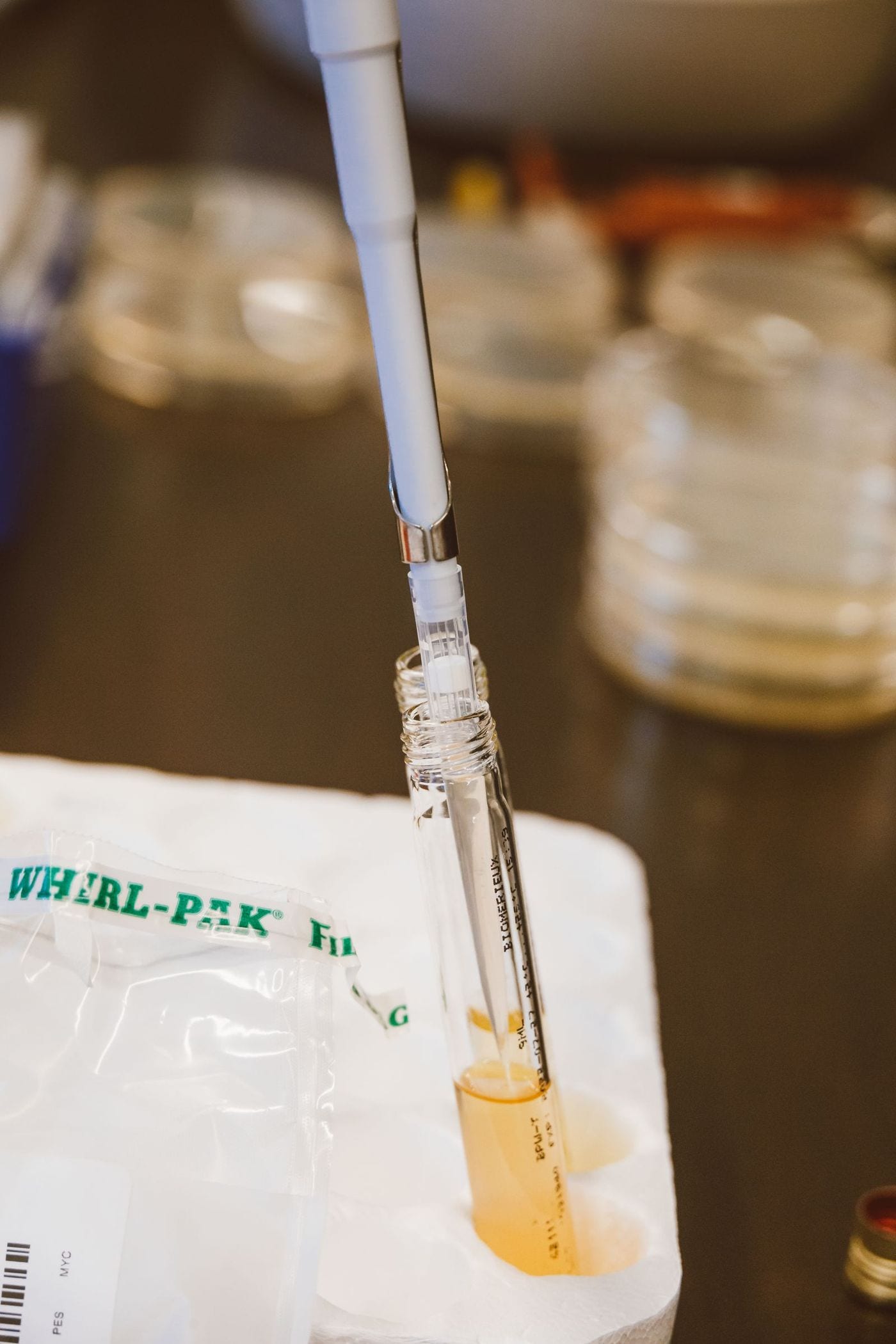
Anthropic says Claude discovered a previously uncharacterized enzyme system in bacteriophage DNA, the first public result from the company’s new molecular biology lab and research group.
According to Anthropic, roughly 950 Claude agents spent about 21 hours and 210 million tokens surveying reverse transcriptase genes. One agent noticed a repeating stretch of non-coding DNA next to an unusual reverse transcriptase—a pattern reminiscent of CRISPR arrays. The company calls the three-part system array-associated reverse transcriptases, or ART: the RT, a partner gene beside it, and an array of evenly spaced DNA repeats. Anthropic says the underlying RT in jumbo phages had been identified in earlier studies; Claude appears to have been the first to flag the associated array and accessory protein.
The company does not yet know what ART does. A preprint released with the announcement has not been peer reviewed. Anthropic reports early lab results that the array is expressed as distinct short RNAs, and that similar combinations of traits in other systems have often meant programmable DNA operations—but the preprint, as summarized in secondary coverage, has not demonstrated that the ART enzyme is active on those RNAs, or that ART is a gene-editing tool. There are no cas genes next to the ART arrays, unlike classic CRISPR-Cas systems.
Anthropic says its Bay Area lab works only at biosafety levels 1 and 2 and does not handle pathogens that infect humans; human scientists perform the wet-lab work. After reviewing the preprint, CRISPR pioneer Feng Zhang of MIT and the Broad Institute said the identification of RNA-repeat arrays associated with reverse transcriptases is “genuinely intriguing and merits further investigation,” calling it an exciting example of AI agents contributing to biological discovery—supportive reaction, not independent replication of the system’s function.
The capability claim is real as a genome-mining result: agents scaled a search humans rarely do at this breadth. The hype risk is treating ART as “the next CRISPR” before anyone proves what it cuts, copies, or pastes—if anything. Biotech upside arrives only if ART turns out to be programmable; for now, Anthropic is publishing early and inviting other scientists to dig in.