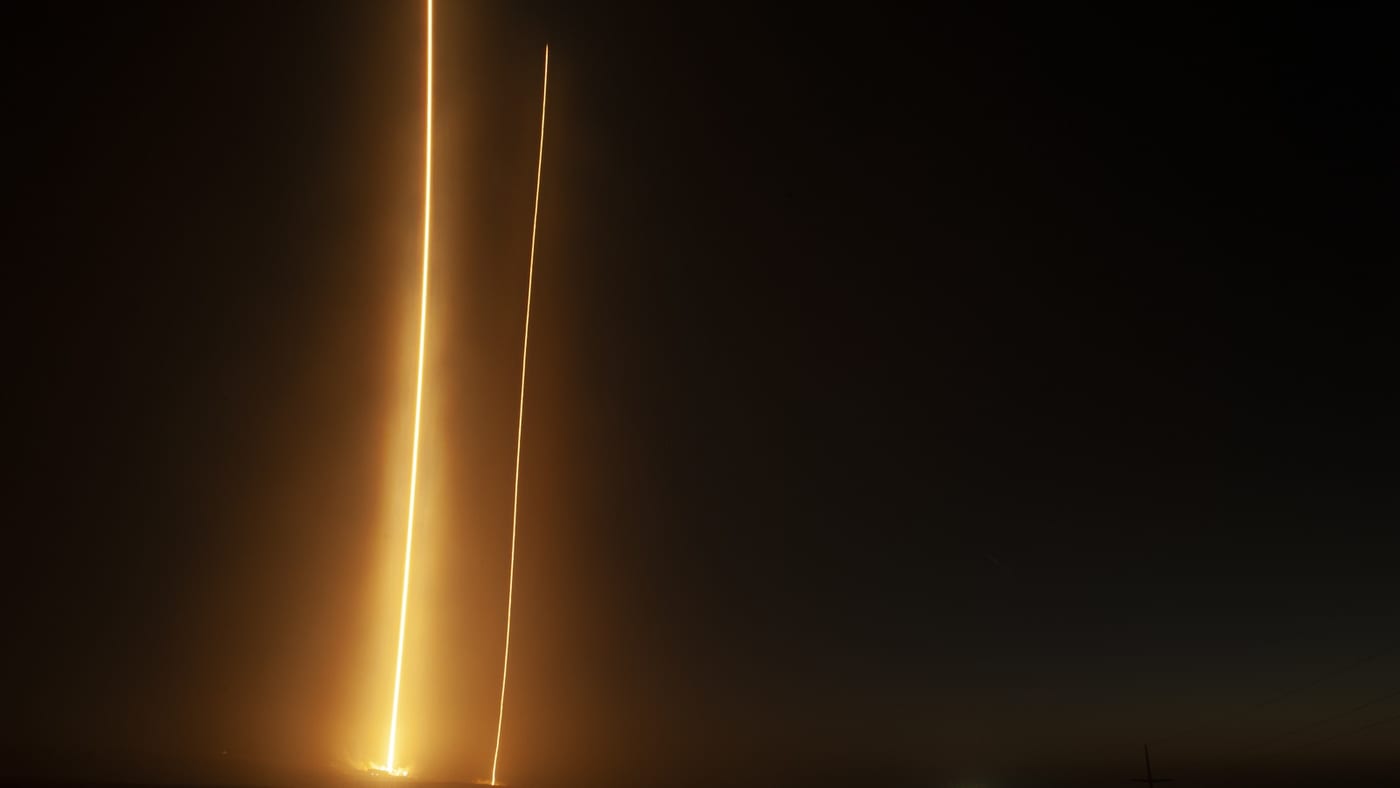
Google confirmed contact Thursday with a prototype satellite now in orbit for **Project Suncatcher**, its research effort to learn whether machine-learning hardware can survive — and eventually operate — beyond Earth.
The spacecraft lifted off Oct. 1, 2026, on SpaceX’s **Transporter-18** rideshare from Vandenberg Space Force Base in California. Roles split cleanly: **SpaceX** provided the Falcon 9 launch; **Planet Labs** built and is commissioning the satellite bus; **Google** supplied the Tensor Processing Units (TPUs) under test.
“Our team has confirmed contact with the satellite and it is operating as expected,” Travis Beals, Google’s senior director of Paradigms of Intelligence and Suncatcher’s public lead, wrote in a company blog post. He called the flight “the first step in a long-term research moonshot exploring whether space could one day host scalable machine learning infrastructure.”
Planet separately said it had made initial contact with the Suncatcher prototype and begun commissioning, alongside other Planet payloads on the same rideshare, including Tanager-2 and SuperDove imaging sats.
Suncatcher is not a commercial cloud region in the sky. It is a qualification-style experiment: can production-class AI accelerators endure launch vibration, space radiation, and the thermal extremes of low Earth orbit when there is no air to cool them?
Over the coming weeks, Google says it will gather in-orbit data on how its TPUs handle those stresses. Company posts describe ground work already done — vibration tables and proton-beam radiation testing of **Trillium** (Cloud TPU v6e) at UC Davis’s Crocker Nuclear Laboratory — but Beals told TechCrunch no ground test replaces flight.
Independent reporting fills in details Google’s short confirmation left out. Ars Technica, NPR, and TechCrunch, citing Google briefings, describe a refrigerator-scale Planet spacecraft carrying **four** TPUs, on the order of about a kilowatt of solar power, intended to run compute only in short bursts of about **15 minutes** so radiators can catch up. NPR reported Gemma-model queries under those thermal limits. Google’s own engineering write-up stresses heat pipes and radiators as the vacuum cooling path.
Those details matter: this is closer to an orbital burn-in and telemetry campaign than to training a frontier model from space.
Google announced Suncatcher on Nov. 4, 2025, with research on solar-powered satellite clusters linked by free-space optical links. In a dawn–dusk sun-synchronous orbit, the company argues, arrays can collect far more energy than typical terrestrial panels — Google cites up to about **eight times** more annual solar energy than mid-latitude Earth sites — with near-continuous sunlight cutting battery mass.
The long-term sketch is ambitious: compact formations, each satellite eventually carrying many TPUs, exchanging data over high-bandwidth lasers. That remains a paper architecture. Thursday’s bird answers a prior question: does the silicon work at all up there?
Planet’s partnership, announced with the project in November 2025, originally targeted **two** prototypes by early 2027 for TPU performance and cross-link tests. Ars reported Google accelerated an earlier single-satellite integration onto a Planet bus. The dual-satellite laser-link demo is still on the 2027 calendar in Google’s September 2026 facts post and in Reuters’ pre-launch coverage. Google also said a peer-reviewed version of its Suncatcher research is now in *Joule*.
For this mission, SpaceX is the loft provider on a crowded smallsat rideshare, not the builder of Google’s compute bus. CNBC reported a clean Falcon 9 ascent from Vandenberg and successful payload deployment. Industry coverage notes Alphabet’s SpaceX stake and parallel orbital-compute interest from SpaceX and startups such as Starcloud — separate tracks that should not collapse into one headline.
Reuters and engineers quoted by NPR underline what is still hard: vacuum cooling, radiation-induced bit flips, launch economics, and no technician walking into a rack in LEO. Beals told NPR he does not expect space compute to undercut terrestrial options within five years, and that Earth and orbit would likely coexist for a long time.
Google’s launch blog does not name the exact TPU SKU on this flight, though ground radiation work centered on Trillium. Public materials do not disclose who paid whom for the rideshare or bus, nor a published operational altitude for the craft SpaceX’s timeline lists as Project Suncatcher M1. Secondary estimates of mission lifetime disagree. None of that should be papered over.
What is solid: on Oct. 1, 2026, SpaceX lofted a Planet-built satellite carrying Google AI chips for Suncatcher’s first on-orbit check. Contact is up. Short inference-style runs and thermal-radiation telemetry come next, with lessons aimed at a 2027 laser-linked pair. The path from that data to anything resembling a space-based training or inference cluster is still a research roadmap — not a product launch.