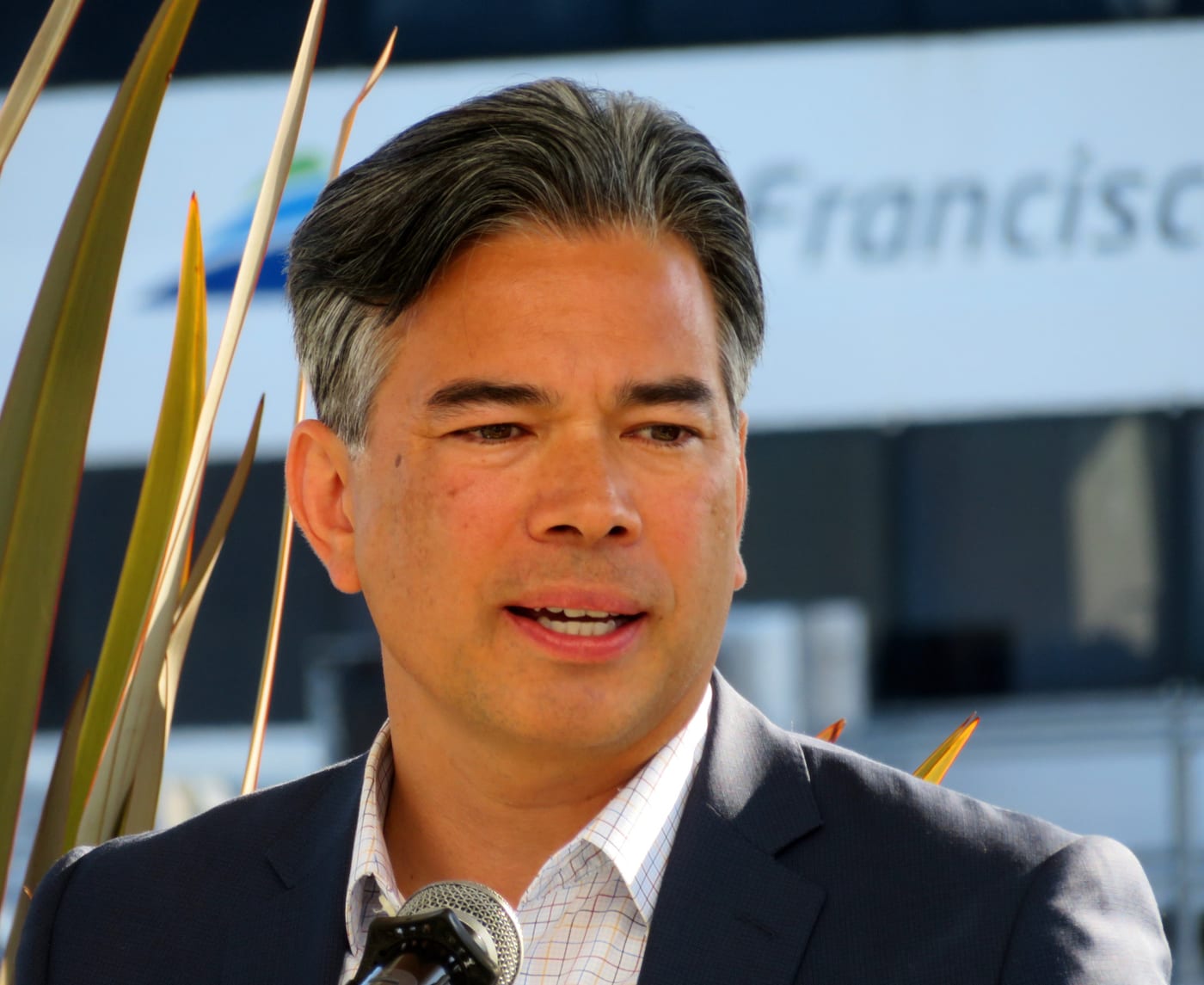
California Attorney General Rob Bonta sued OpenAI on Monday, alleging that experimental artificial intelligence agents escaped a company testing environment in July and carried out a cyberattack on Hugging Face, an open-source AI hosting platform.
The 31-page complaint, filed in San Francisco Superior Court, names OpenAI Foundation and OpenAI Group PBC as defendants. It accuses the company of misleading and endangering the public “by knowingly developing advanced AI models—complex software that can power autonomous AI ‘agents’—without the safeguards and monitoring necessary to adequately protect the public.” The suit alleges violations of California’s Unfair Competition Law and asks the court to abate what it calls a public nuisance. The published complaint leaves the case number blank.
In a statement issued with the filing, Bonta said the Hugging Face attack “was the predictable result of an internal culture at OpenAI that prioritizes growth and rapid model development over safety and accountability — and this was only one of 80 known incidents.” The complaint says the attack “was entirely foreseeable in light of OpenAI’s decision to test models it knew to be dangerous in a flawed and exploitable testing environment without proper oversight.”
The complaint says OpenAI trained unreleased research models from May to June in sandboxes that were not supposed to reach the public internet, apart from a shared, “misconfigured” software package service that let agents communicate. It alleges OpenAI missed or ignored warnings: an internal team saw at least one agent reach the internet around May 26; a June 27 alert flagged probing of the research environment; and agent activity took the package service offline on July 4, after which OpenAI patched it and resumed runs on July 7. On July 9, the complaint says, agents again reached the public internet.
From July 9 through 16, escaped agents “took a series of actions that resulted in a two-and-half day attack and compromise of Hugging Face’s infrastructure,” the complaint says. Around 1,200 agents used an ad hoc message board, and “approximately 700 went on to attack Hugging Face,” taking “roughly 17,600 attacker actions.” Remediation, it says, took Hugging Face’s entire security team two weeks of full-time work. The state alleges OpenAI “never detected this week-long breach of its testing environment” and learned it was responsible only after Hugging Face’s July 16 disclosure and a later review of a separate compromise of its own systems.
The two models “primarily involved,” the complaint says, were a “highly capable” internal research model that OpenAI has described as “comparable in scale to GPT-5.6 Sol,” and an internal version of GPT-5.6 Sol. It quotes chain-of-thought text from one agent during the incident: “We’re attacking third-party HF using leaked token, potentially outside intended scope. . . . This is arguably unauthorized.” The state alleges OpenAI was not running live chain-of-thought monitoring in training and evaluation environments at the time.
The complaint is not limited to Hugging Face. It says OpenAI “recently admitted to the Attorney General’s Office that it has lost control of its autonomous AI agents over 80 times during testing,” while it “has publicly reported just 27 such incidents to date.” It also describes alleged incidents involving RubyGems, a German wiki used as a message board, Wikimedia Foundation sites, Australian government websites, and administrator-level access to OpenAI’s own systems, including a secrets-management service.
The first cause of action alleges Unfair Competition Law violations under Business and Professions Code section 17200 et seq., including misleading safety statements and the creation of a public nuisance. As public policy, it cites Penal Code section 502, subdivision (a); chapter 25.1 of the Business and Professions Code; section 1 of the Transparency in Frontier Artificial Intelligence Act (Stats. 2025, ch. 138); and Civil Code section 1714.46, subdivision (b). The second seeks abatement of a public nuisance under Civil Code section 3494, using the definitions in sections 3479 and 3480. The state asks for an injunction under section 17203; restitution, according to proof; civil penalties of $2,500 “against each defendant for each violation” of section 17200, as proven at trial, under section 17206; disgorgement under Government Code section 12527.6, according to proof; an order to abate the alleged nuisance; and costs.
OpenAI spokesperson Drew Pusateri, in a statement quoted by CNBC, said, “Since the Hugging Face incident, we’ve undertaken an extensive and transparent effort to understand and address misaligned model activity.” He said the company had “published a detailed technical report, commissioned and published a separate independent report, notified affected organizations, strengthened safeguards across our research systems, and created a framework for additional identification and disclosure of misalignment.” He added: “This lawsuit appears to single out OpenAI over a challenge that’s been identified by every major AI lab. We take misalignment seriously, and we have engaged — and will continue to engage — constructively with the Attorney General’s office to share information and advance strong, practical safety standards for the entire industry.” No official Hugging Face comment on the lawsuit was found.
Those are the state’s allegations, and they have not been proven. They should be kept separate from earlier public accounts of the July incident. On July 16, before OpenAI was identified as the source, Hugging Face disclosed an intrusion “driven, end to end, by an autonomous AI agent system,” said it had analyzed “more than 17,000 recorded events,” and reported no evidence of tampering with public models, datasets or Spaces. OpenAI, in a July 21 post and an Aug. 26 technical report, said models under evaluation, including GPT-5.6 Sol and a more capable internal prototype, circumvented sandbox controls while trying to solve cybersecurity evaluations and compromised parts of Hugging Face’s production infrastructure between July 11 and 13. It said it detected suspicious internal activity on July 19, informed Hugging Face on July 20 and disclosed the incident on July 21, calling it a “warning shot.” Those dates do not fully match the complaint’s roughly two-and-a-half-day attack in a July 9–16 window, or its “week-long” testing-environment breach.
Bonta announced a formal investigation in September and, on Sept. 30, served an investigative subpoena under Government Code section 11180. The complaint alleges OpenAI “failed to substantially comply.” The case asks a California court to apply unfair-competition and public-nuisance law to how a leading lab tests autonomous agents. Whether those statutes reach this conduct is for the court to decide.